
Michigan Sex Offender Checks
The Michigan Public Sex Offender Registry is the official public search. Michigan State Police distinguishes it from the Michigan Sex Offender Registry, or MSOR. MSOR is the broader law-enforcement database. Michigan PSOR publishes only the part that Michigan law makes public. That distinction matters. A person may have an MSOR record yet have no public Michigan PSOR profile because of juvenile status, a completed duty, a move from Michigan, judicial removal, the date or type of the conviction, or another statutory rule.
Michigan's Sex Offenders Registration Act took effect in 1995. It creates the central registry and local reporting duties. Police departments, sheriff offices, and Michigan State Police posts conduct in-person registration and verification. The Michigan State Police Sex Offender Registry Unit maintains the statewide system. Michigan PSOR is free and spans all 83 counties. It supports safety awareness, but the listing itself is not a finding that a person will commit a future offense.
The official portal view can be seen in the Michigan PSOR search interface.
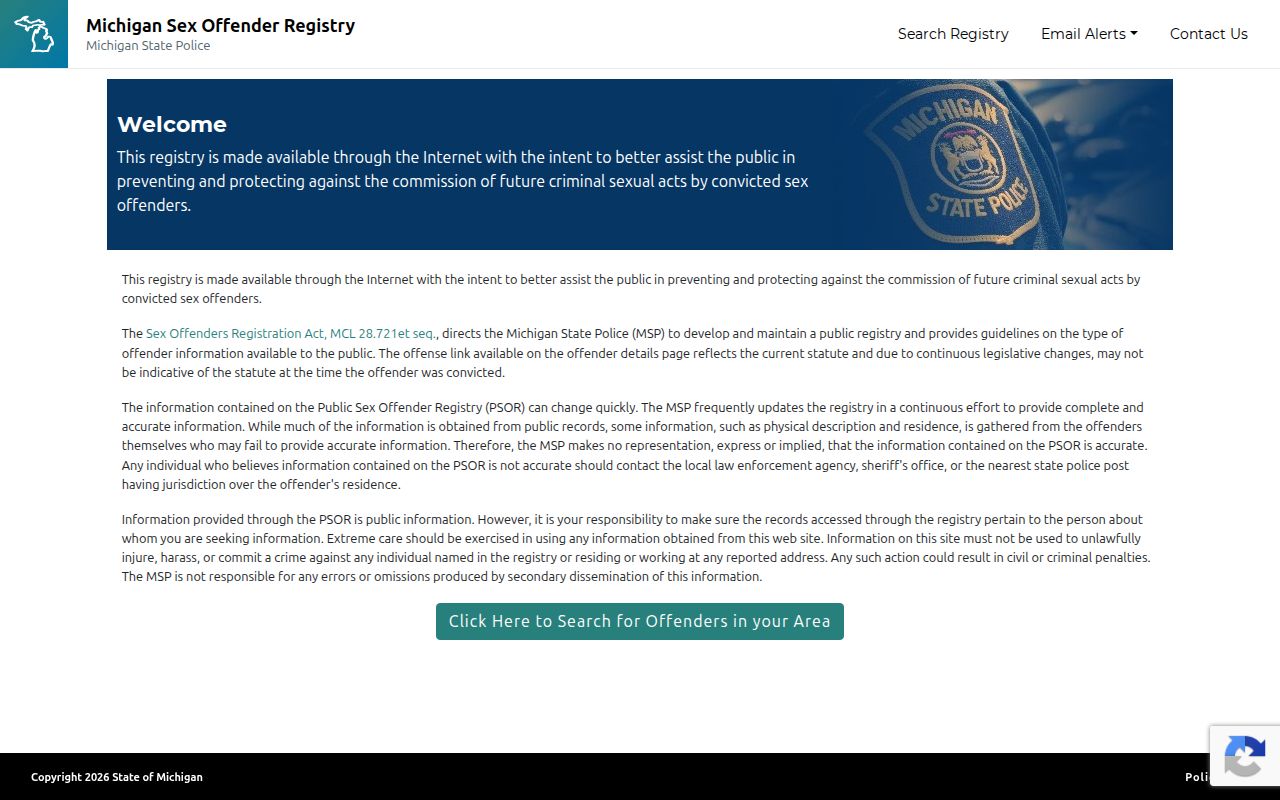
The interface joins name, place, map, list, and profile tools without turning Michigan PSOR into a bulk-download database.
Michigan MSOR and PSOR Compared
Michigan MSOR and Michigan PSOR serve different audiences. Michigan MSOR contains public and nonpublic registration data used by authorized agencies. Michigan PSOR is the public-facing subset. Victim identity is never published. Adjudicated juvenile information and other legally restricted data also stay off the Michigan public site. A failed public search therefore proves only that Michigan PSOR returned no matching public profile.
For a historical case, use the conviction court. For a current public registration, use Michigan PSOR. For another jurisdiction, the U.S. Department of Justice National Sex Offender Public Website searches participating registries and points back to their source records. The national layer depends on each jurisdiction's data and does not replace Michigan's profile.
The national search structure is shown by the official NSOPW service.
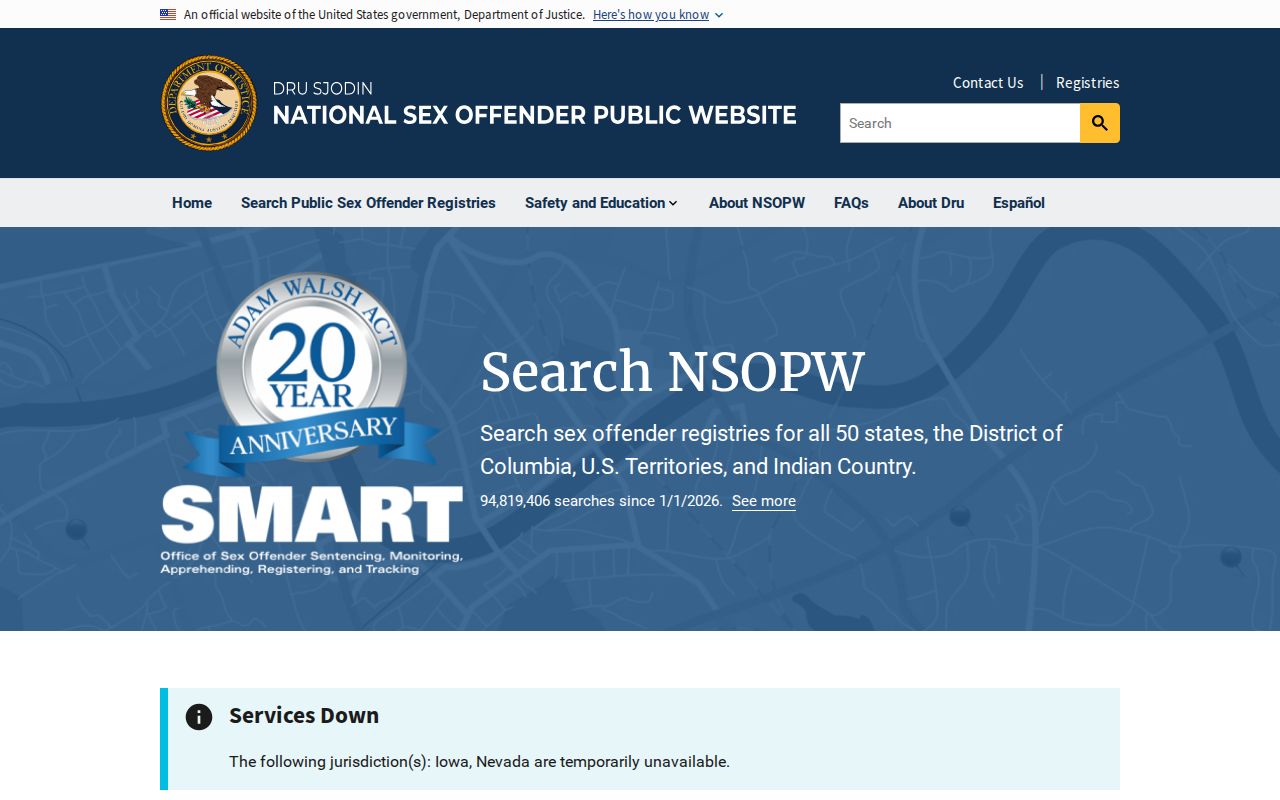
Use NSOPW when a person may have moved, then verify a Michigan result in Michigan PSOR and with the responsible registering agency.
Michigan Public Sex Offender Registry (PSOR) Search Steps
Michigan PSOR offers several paths. A name search accepts partial first and last names. An identifier search uses a registration or MDOC number. Place searches accept city, county, ZIP, and conditional street data. A neighborhood map can be centered on an address with a radius from one-quarter mile through five miles. Start broad, then confirm identity through the record's photograph, date of birth, aliases, registration number, and physical description.
- Open the official Michigan PSOR and choose a name, identifier, registry, or neighborhood-map search.
- Enter the fewest reliable fields. Try a partial name or widen the location if the first search is empty.
- Open View Details and compare the photograph, aliases, date of birth, descriptors, and offense data.
- Use Map Offender, Track Offender, or an address alert only after confirming the profile.
| Field Label | Type | Required | Notes |
|---|---|---|---|
| First and Last Name | Text | Yes for name search | Partial names are accepted. |
| Registration or MDOC Number | Text | Alternative | Either identifier can open a direct search. |
| City, County, or ZIP | Text / dropdown | No | Finds published Michigan profiles by place. |
| Street Address | Text | Conditional | Combine with city, county, or ZIP for Registry Search. |
| Neighborhood Map Radius | Dropdown | Yes for radius search | Choose 0.25, 0.50, 1, 2, or 5 miles. |
| Email Alerts | Signup | No | Save an address radius after accepting the terms. |
Note: A map marker is a location aid, not proof about a property line, household, nearby school, or active warrant.
Michigan Registry Radius Alerts
Michigan PSOR has two related notice tools. Michigan address alerts watch a chosen radius. The Michigan registration form asks for an address, city, state, ZIP, email confirmation, search radius, and agreement to the terms. A post-office box cannot set the location. Michigan State Police says the confirmation message should arrive within 24 hours. Several addresses may use one email account.
Track Offender follows one confirmed public profile. It can send notice after a reported move, school event, or employment-location event. Neither tool authorizes following or contacting anyone. Both depend on data reaching the registry. For broader victim and custody notifications, Michigan's registry and MI-VINE guidance describes the separate notification channels.
The Michigan notification options appear in the official victim and registry guidance.
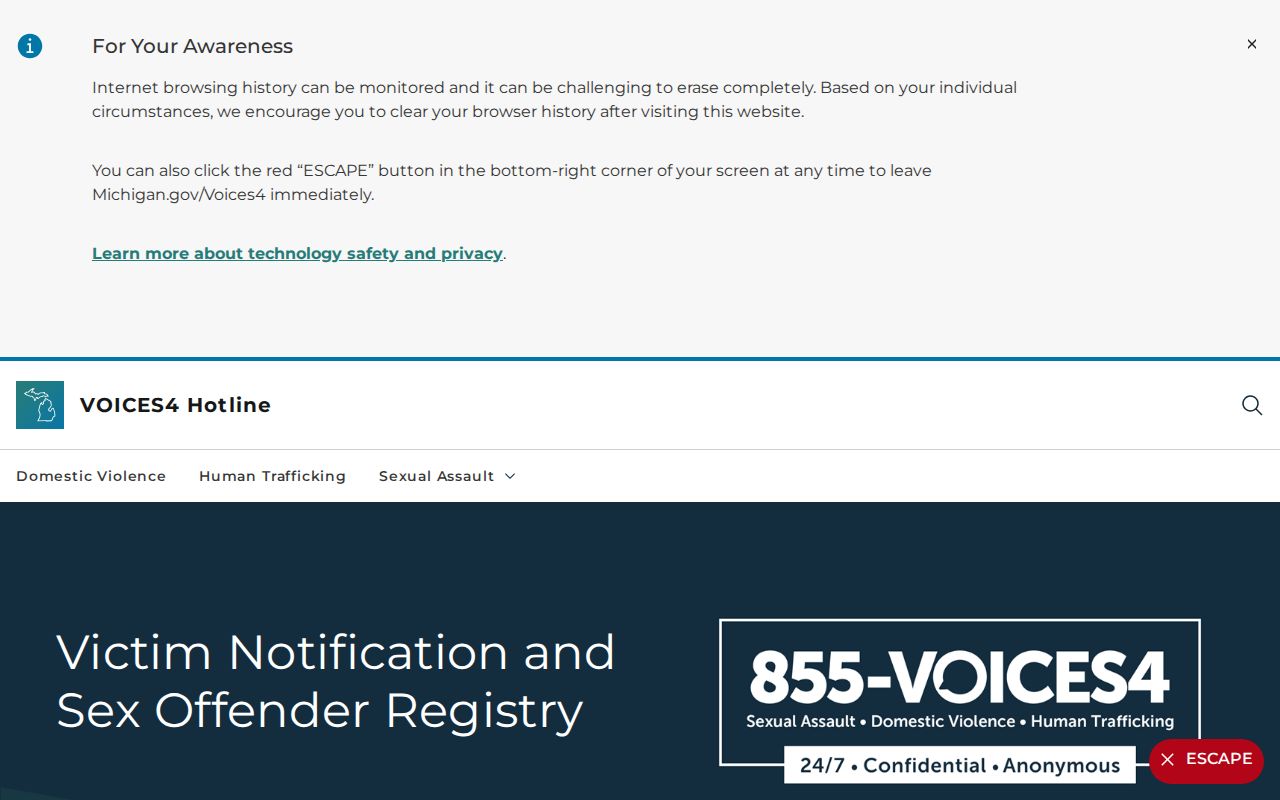
These tools support passive awareness. Immediate danger belongs with 911, while a data concern belongs with the registry or local police.
What a Michigan Registry Profile Lists
A Michigan PSOR profile combines identity, registration, location, offense, and compliance fields. Read each field by its label. “Active” means a current registration duty, not custody or a new accusation. “Incarcerated” is a custody status. “Absconder” is an official registry status that should be reported to law enforcement, not investigated. “Homeless,” “School Only,” and “Employment Only” each describe a registry category, not a prediction of conduct.
| Name & Aliases | Public name, prior names, registration number, and MDOC number when applicable. |
|---|---|
| Photograph & Description | DOB, sex, race, height, weight, hair, eyes, and listed scars, marks, or tattoos. |
| Address & Status | Published residence or status, map control where geocoded, and current registry category. |
| Offense Details | Public offense, jurisdiction, conviction date, court information, and related tier data. |
| Registration | Tier, term, verification cycle, start or end fields where shown, and public duty details. |
| Compliance Flags | Exact labels for address, verification, form, fee, ID, vehicle, telephone, campus, or other duties. |
A flag is a data or compliance condition. It does not, by itself, prove every element of a new crime. Preserve the wording and date. Then ask the registering agency to confirm it.
Correcting Michigan PSOR Results
Recent moves, delayed reports, rural routes, apartment buildings, and geocoding limits can create a surprising address display. The Map Offender button may be unavailable when an address cannot be mapped. A Failed to Verify flag concerns the periodic in-person cycle. Address, Campus, Telephone, Vehicle, Form, Fee, and similar flags refer to their named duties. None should be paraphrased as “wanted” without a court or law-enforcement source.
If a Michigan PSOR address or status looks wrong, open the profile and use Submit a Tip. The other route is the police department, sheriff office, or Michigan State Police post where the person actually resides. Michigan State Police's Sex Offender Registry guidance also lists the Michigan registry unit information line at 517-241-1806 and hotline at 866-761-7678. Check the Michigan conviction and any removal order in the court file.
The official help and duty material is illustrated by the MSP registry guidance.
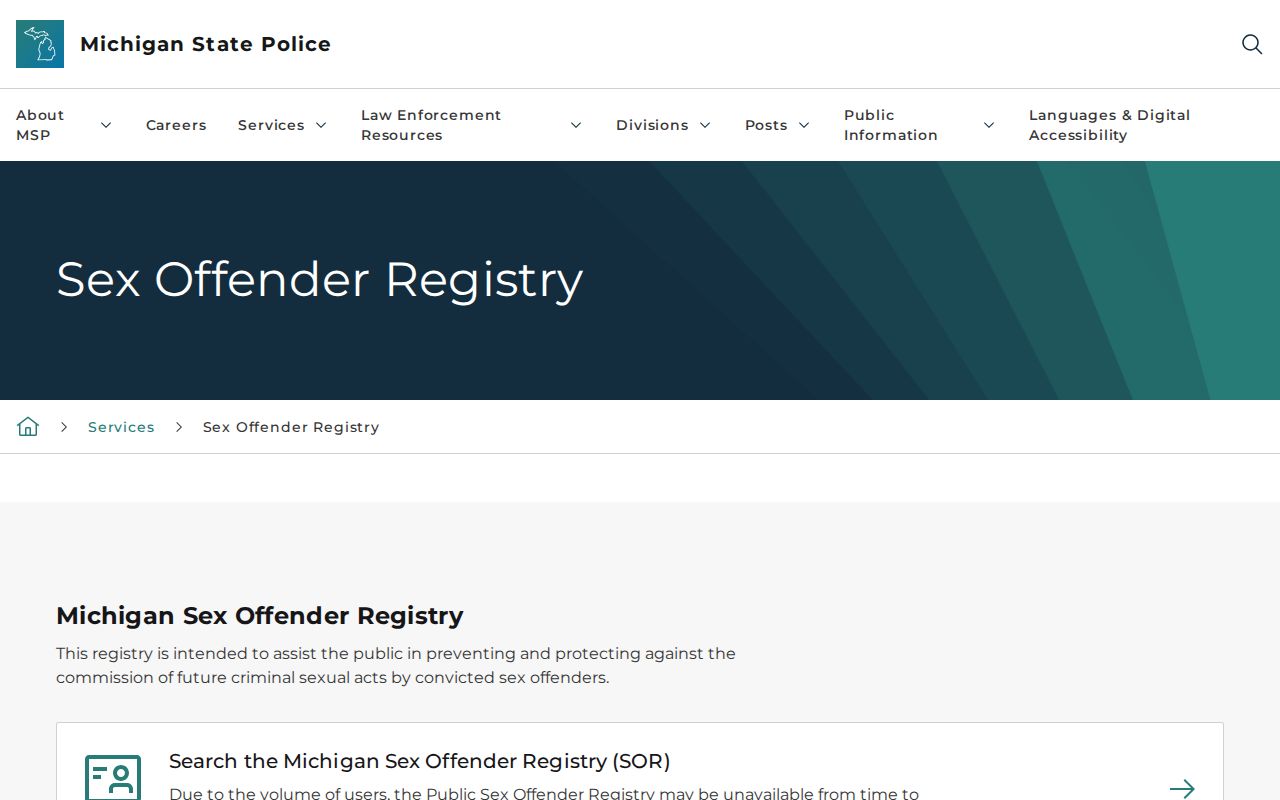
The source separates public-search questions, registration duties, profile statuses, alerts, and reporting channels.
Registry Levels and Requirements in Michigan
Michigan uses offense-based Tier I, II, and III categories. They are not individualized “risk levels.” The Michigan tier helps set the statutory registration term and in-person verification cycle. Older Michigan convictions may be affected by past amendments, litigation, or a court order, so the current chart should not be applied to an old judgment without checking the official Michigan profile and case file.
| Michigan Tier | Duration | Verification Frequency |
|---|---|---|
| Tier I | 15 years, subject to statutory reduction or exceptions | Annually in the birth month |
| Tier II | 25 years | Semiannually, keyed to birth month |
| Tier III | Life | Quarterly, keyed to birth month |
Registrants generally must report certain residence, work, name, and higher-education changes in person within three business days. Other rules cover temporary lodging, vehicles, phone changes, moves, and travel. Michigan's former statewide 1,000-foot student safety zone restrictions were repealed in 2021. A local rule or individual supervision order may still differ.
Michigan Registry Audit Context
An October 2025 Auditor General review reported about 44,000 active MSOR registrations as of July 25, 2024. That figure is not a live count of public Michigan PSOR profiles. Public totals differ because some records are nonpublic, inactive, incarcerated, out of state, or otherwise treated under Michigan law.
The Michigan audit used samples and assessed Michigan State Police's oversight of a third-party service organization, cancellations, out-of-state documentation, data integrity, and verification controls. It found Michigan State Police monitoring was not sufficient and made recommendations. Its sample results cannot be projected across all registrations. The sound response to a surprising profile is to check with Michigan State Police, the local registering agency, and the conviction court, not to discard the public record or substitute a commercial list.
Verification point. Michigan PSOR may lag a local report, and the portal can be busy. Save the exact status and date before contacting the responsible agency.
Michigan County Registration Duties
Registration and verification happen in person through the local law-enforcement agency, sheriff office, or Michigan State Police post with jurisdiction. The right office turns on actual residence and circumstance. A registrant also pays a one-time $50 initial fee and $50 each year after that, capped at $550 under current Michigan State Police guidance. Michigan PSOR searching remains free.
Local questions should go to the Michigan county layer. Use the Michigan county records directory to reach the correct sheriff, police agency, and district or circuit court. The court holds the conviction file. The local registering agency confirms the current address and compliance data. Michigan State Police maintains the central registry. Keeping those roles separate avoids treating a web profile as the complete case.
Note: Public absence may reflect a legal publication rule, completed term, removal, move, or nonpublic record rather than no prior Michigan case.
Using the Michigan Public Sex Offender Registry (PSOR) Lawfully
Michigan publishes PSOR for public and law-enforcement awareness. It may help residents understand who appears near a saved address, follow a confirmed profile, or identify the county court that holds a conviction file. It does not authorize contact, surveillance, threats, or retaliation. Never seek victim details. Michigan law protects them from release.
The Michigan Sex Offenders Registration Act controls public and nonpublic registry information. Michigan State Police warns that users may not threaten, intimidate, harass, or commit a criminal act against a registrant. A suspected Michigan violation belongs with law enforcement. An immediate threat belongs with 911.
Misuse is a crime. Do not use Michigan PSOR information to threaten, intimidate, harass, or commit an unlawful act. Report safety and compliance concerns to law enforcement.