
How Michigan Courts Handle Criminal Cases
Michigan divides trial work by both charge level and procedural stage. A Michigan district court generally tries misdemeanors carrying no more than one year in jail. It also handles the complaint, arraignment, bond, probable-cause conference, and preliminary examination in a felony matter. If the felony is bound over, the Michigan Circuit Court becomes the trial court for the information, plea or trial, judgment, and sentence. Four Michigan municipal courts remain in the Grosse Pointe area and have limited ordinance and misdemeanor jurisdiction. Appeals can move from a Michigan trial court to the circuit court, Michigan Court of Appeals, and Michigan Supreme Court as the governing review path allows.
The clerk for each court keeps the official Michigan case record. MiCOURT can display an index or register from participating courts, yet the portal does not turn separate court files into one merged dossier. A case file also differs from the compiled rap sheet kept by the Michigan Department of State Police Criminal Justice Information Center. The court file shows the prosecution in one court. The CJIC record links reportable fingerprint-based arrest and disposition cycles from across Michigan.
The Michigan Judiciary trial-court directory shows how the court system is arranged.
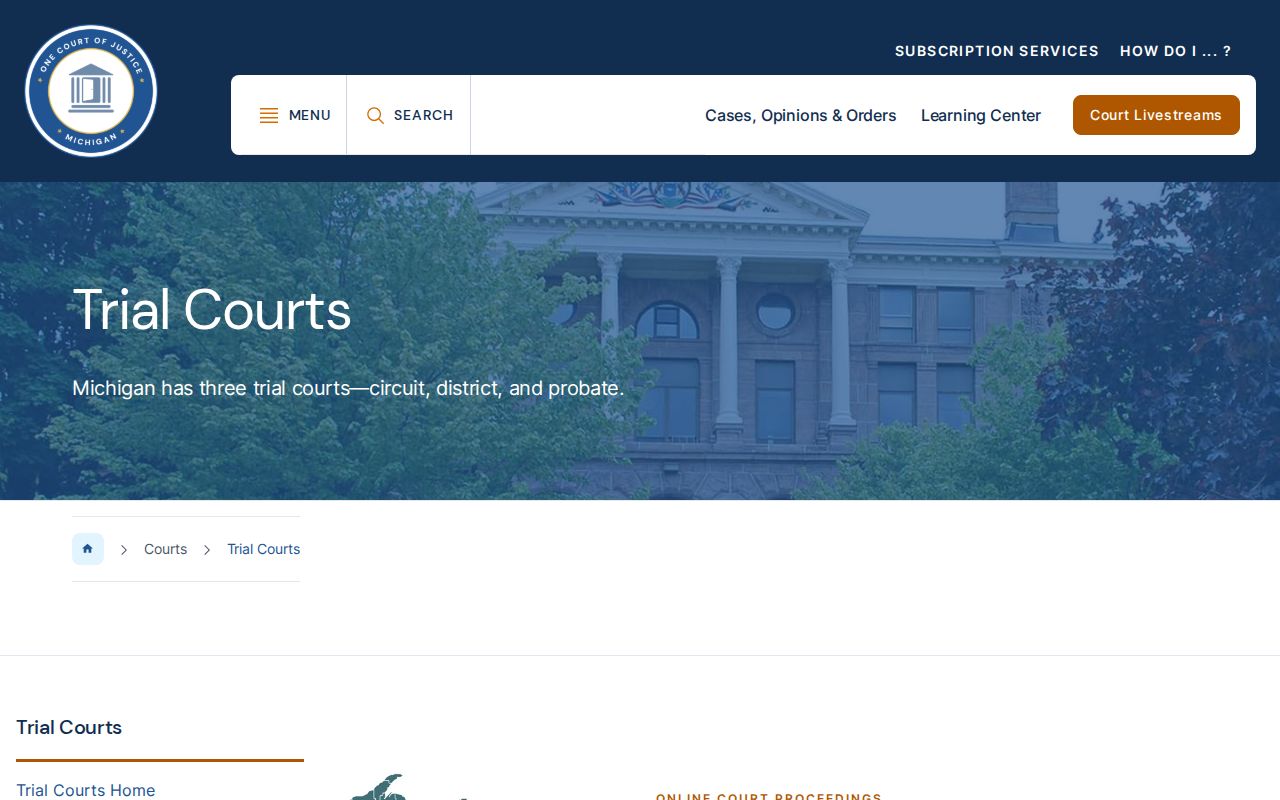
That directory is the statewide route to the exact district, circuit, probate, or municipal court that owns a record.
Michigan MiCOURT Coverage Gaps
MiCOURT is a Michigan court-by-court search, not a complete Michigan statewide index. A Michigan user first selects a participating court or location. Some courts mark a seven-year criminal sentence filter, which limits displayed criminal conviction case information to matters sentenced within seven years of the search. Other Michigan courts use their own platforms. Juvenile and child-protective matters, personal protection order cases, name changes, mental-health cases, and other restricted categories do not appear as ordinary public results.
An empty result has several meanings. The chosen court may not participate. A name may be spelled another way. The record may be old, restricted, set aside, or already transferred after felony bindover. The portal also warns that attempt cases can display “FELONY” even when Michigan law treats an attempt to commit a felony punishable by under five years as a misdemeanor. Confirm the underlying statute, maximum penalty, and clerk's file before relying on that label.
The official MiCOURT Case Search shows its terms and participating-court selection before a search begins.
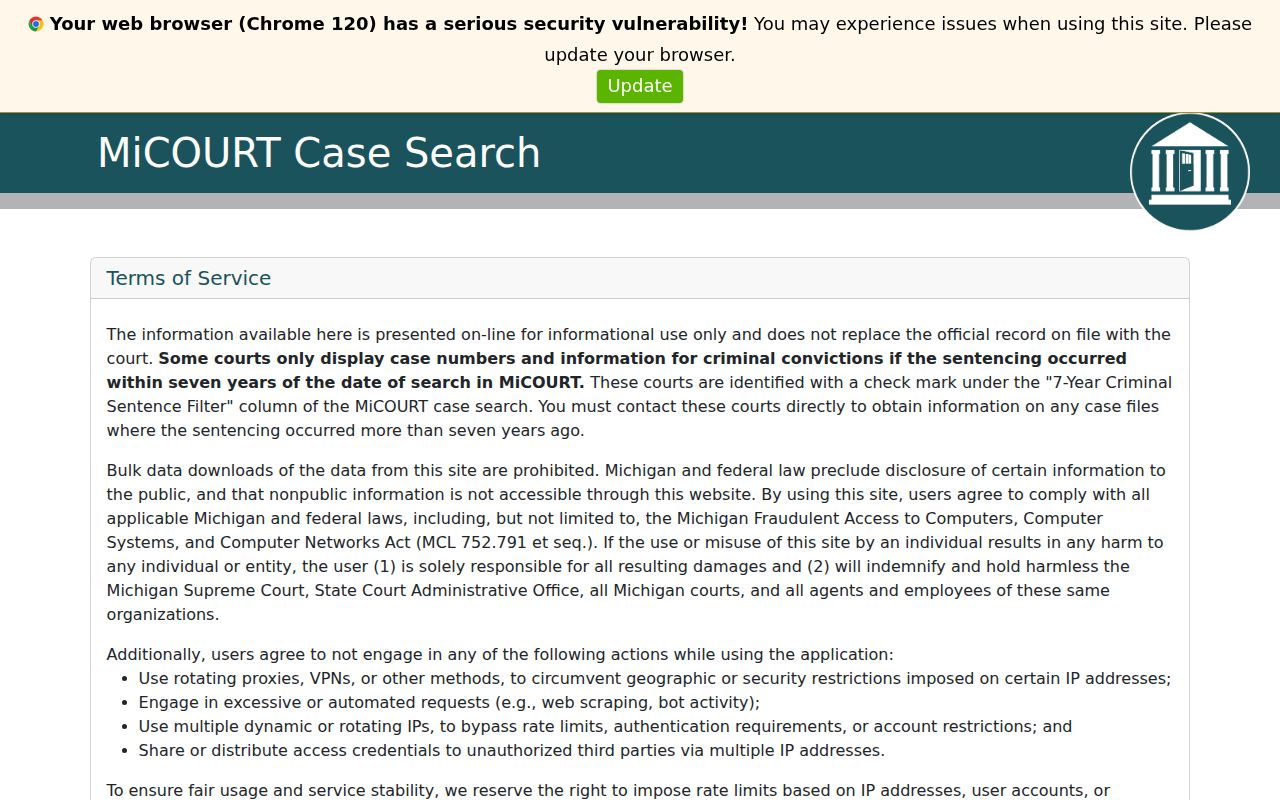
The Michigan court selector and coverage notice are as important as the name typed into the form.
Note: A missing Michigan MiCOURT result does not prove that no criminal case exists in the selected court.
Running a MiCOURT Case Search
Start with the county and the likely court level. A new felony begins in district court, but a bound-over felony moves to circuit court. A misdemeanor normally remains in district court. MiCOURT searches one selected court by a party name or court-formatted case number. Date of birth is not a normal field on the basic public name form, even though secured justice workflows may use more identifiers.
- Open MiCOURT and review the court list, including any seven-year filter notice.
- Select the district, circuit, or municipal court that should hold the Michigan criminal case.
- Choose the name or case-number path. Enter the last name, add the first name to narrow, or use the known case number.
- Read the status, charges, events, and disposition as separate fields. Do not treat a filed charge as a judgment.
- Ask the clerk for the complaint, information, judgment, register, or certified copy when the online index lacks the document.
| Field Label | Type | Required | Notes |
|---|---|---|---|
| Court selection | Searchable list | Yes | Choose one participating Michigan court or location. |
| Name / Case Number | Search path | One path | The public Michigan interface separates these two routes. |
| Last Name | Text | Yes, for name | Use the Michigan party's public-facing last name. |
| First Name | Text | No | Add it to narrow common-name Michigan results. |
| Case Number | Text | Yes, for number | Formats vary by Michigan court; containing-value search may work. |
| Search / Reset | Buttons | No | Michigan results and page controls follow a valid query. |
The official MiCOURT field reference documents added filters for authorized or technical interfaces.
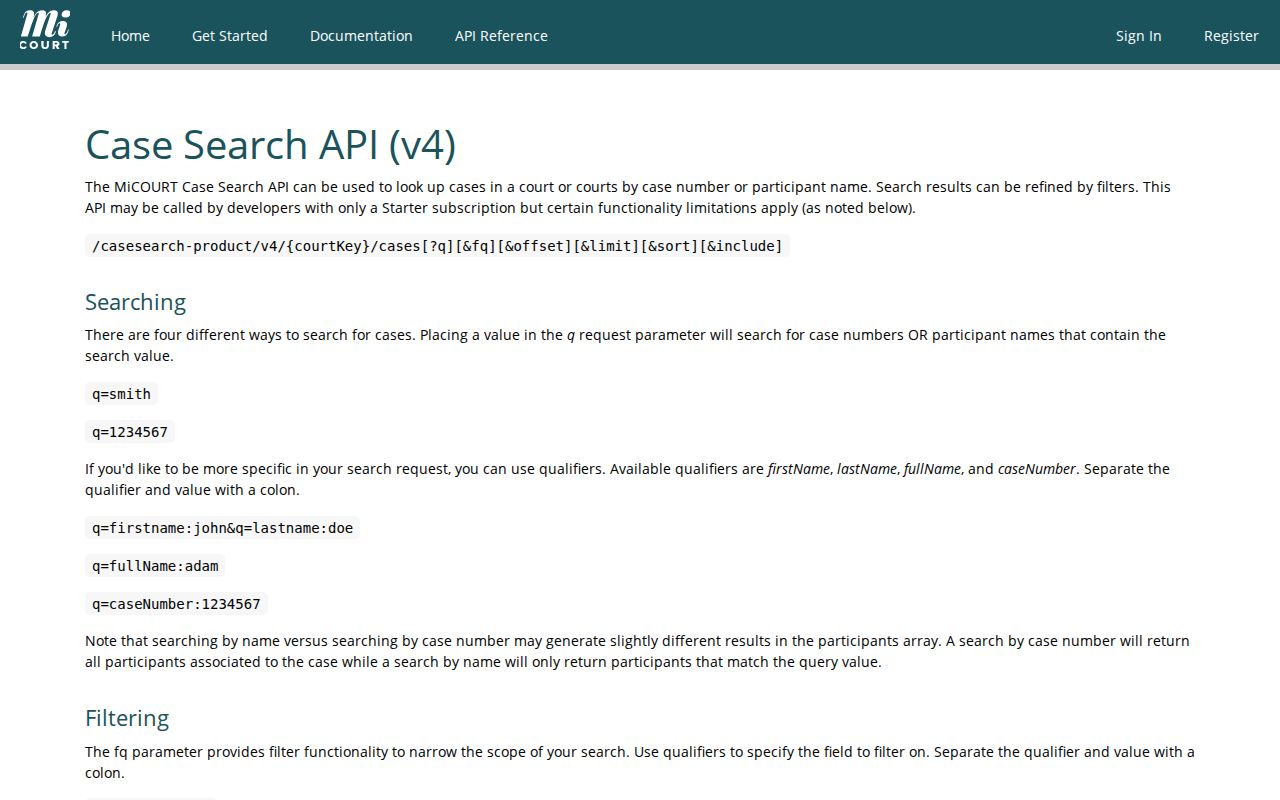
Those Michigan technical controls should not be mistaken for fields offered on every public Michigan case-search screen.
Note: Public MiCOURT searches normally require one selected court and either a name or a case number.
Michigan Felony Bindover Shift
A Michigan felony can seem to vanish from the lower-court search when it has actually moved. The Michigan district court creates the complaint-stage file and holds arraignment, bond, probable-cause, and preliminary-examination records. After probable cause is found or examination is waived, bindover sends the case to circuit court. There, the prosecutor files the information and the public felony proceeding continues through plea, trial, judgment, and sentence.
Since July 2, 2024, Michigan Court Rule 8.119(H)(10) makes the district or municipal record nonpublic as soon as a felony is bound over. The record sent to circuit court remains the public route. Search the circuit court with the transmitted case details rather than concluding that the charge was dismissed. This rule also explains why a person may see an early event in one court and the later disposition in another.
What a Michigan Case File Contains
A Michigan case detail screen can show the court, case number, judge, filing date, status, case type, public parties, attorneys, charges, and register of actions. The charges section may give the count, description, Michigan statute, offense date, level, and disposition. The event list can trace a complaint, arraignment, preliminary examination, bindover, information, motions, plea, trial, judgment, sentence, probation, or warrant event. Bond and financial fields vary by court.
| Case Number & Court | Identifies the specific Michigan court file and the clerk who controls it. |
|---|---|
| Charging Documents | The complaint starts the Michigan case; an information states bound-over felony charges in circuit court. |
| Docket Entries | The Michigan register lists filed events and orders, but a title does not guarantee an online image. |
| Hearing Dates | Shows scheduled or completed Michigan events, locations, and results when the court publishes them. |
| Disposition | Records a Michigan dismissal, acquittal, plea, verdict, transfer, or another outcome by charge. |
| Sentence & Judgment | States the Michigan court's final sanctions, which may include custody, probation, fines, costs, and restitution. |
Protected personal data, victim details, sealed material, set-aside files, and nonpublic Michigan case types are withheld. Online information is useful for locating the Michigan case. The clerk's official Michigan court file controls when accuracy or certification matters.
Michigan Court Access Rule
Michigan court records are not obtained through the Michigan Freedom of Information Act because courts are outside FOIA's public-body definition. Public access instead rests on court rules and other governing law. Michigan Court Rule 8.119 permits inspection and copying of public case records unless a statute, court rule, or valid order makes material nonpublic.
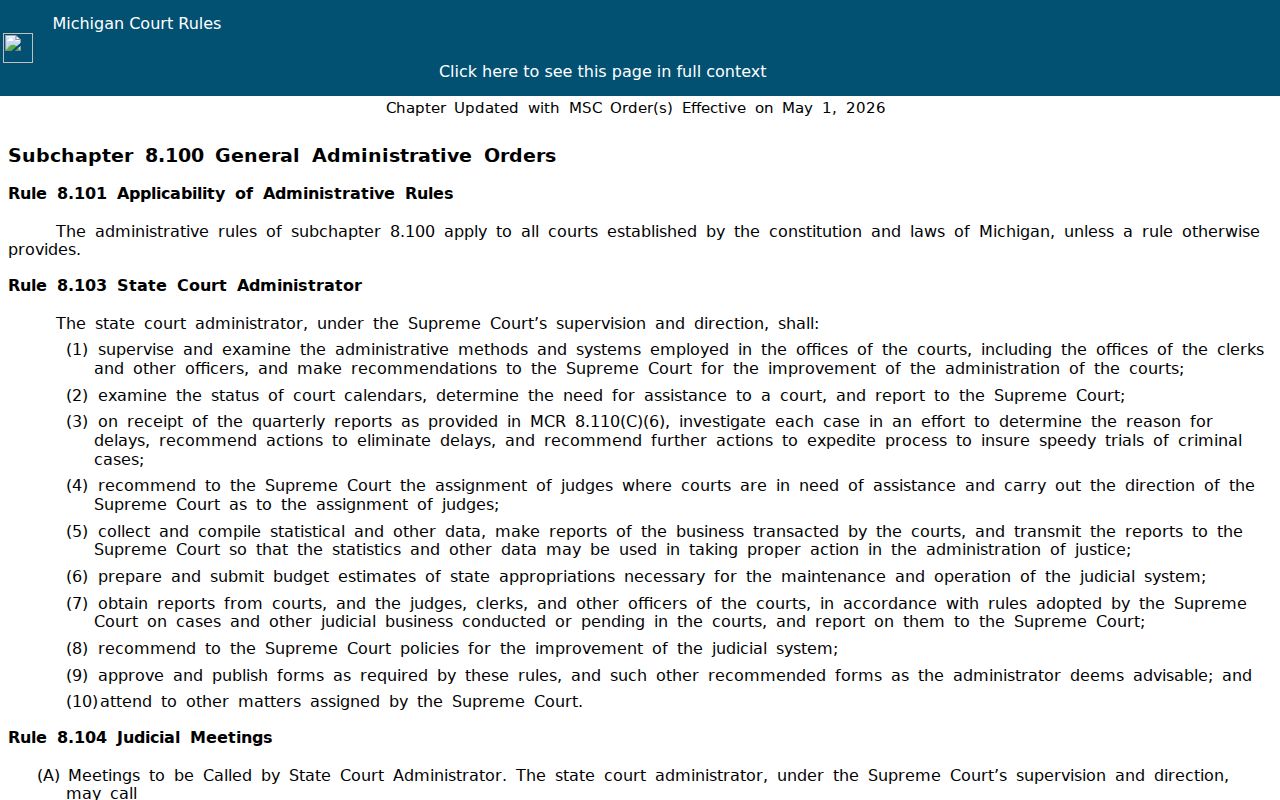
The Michigan rule points back to the Michigan clerk as custodian of the official file, even when MiCOURT supplies the first lead.
Older Michigan files may remain onsite, in storage, on microfilm, or under an approved retention schedule. Give the clerk the party name, Michigan court, case number if known, and an approximate filing year. Search aliases and spelling variants. A modern portal's date range does not define the full age of the court's holdings.
Note: Michigan FOIA does not govern court files, so direct a public inspection request to the clerk.
Michigan Criminal Case Stages
Each Michigan stage creates a different public clue. A complaint starts the Michigan court matter after charge approval. At arraignment, the charge is stated and bond may be set. A felony then moves through a probable-cause conference and preliminary examination or waiver in district court. Bindover leads to the circuit information. Motions, a plea, or a trial follow. The disposition states what happened to each charge, and the judgment records a sentence after conviction.
Case flow: Charges Filed › Arraignment › Pretrial › Plea or Trial › Disposition › Sentencing
Terms must be read with care. “Nolle prosequi” means the prosecutor chose not to continue a charge. An acquittal is a not-guilty result. A dismissal ends a charge without conviction, while a conviction follows an accepted plea or verdict. A set aside changes public treatment of an eligible Michigan conviction but does not mean that all government-held information was destroyed.
Michigan County Portal Exceptions
Several large Michigan circuits have historically used systems outside the statewide JIS pattern. Oakland County Court Explorer is a representative example. It lets a circuit or probate user search by case number or party, read case and party data, view a register of actions, and order available documents. That county's stated copy and certification prices apply only there. They must not be carried over to another Michigan court.
The official county Court Explorer interface demonstrates why MiCOURT cannot be the last stop for every Michigan court lookup.
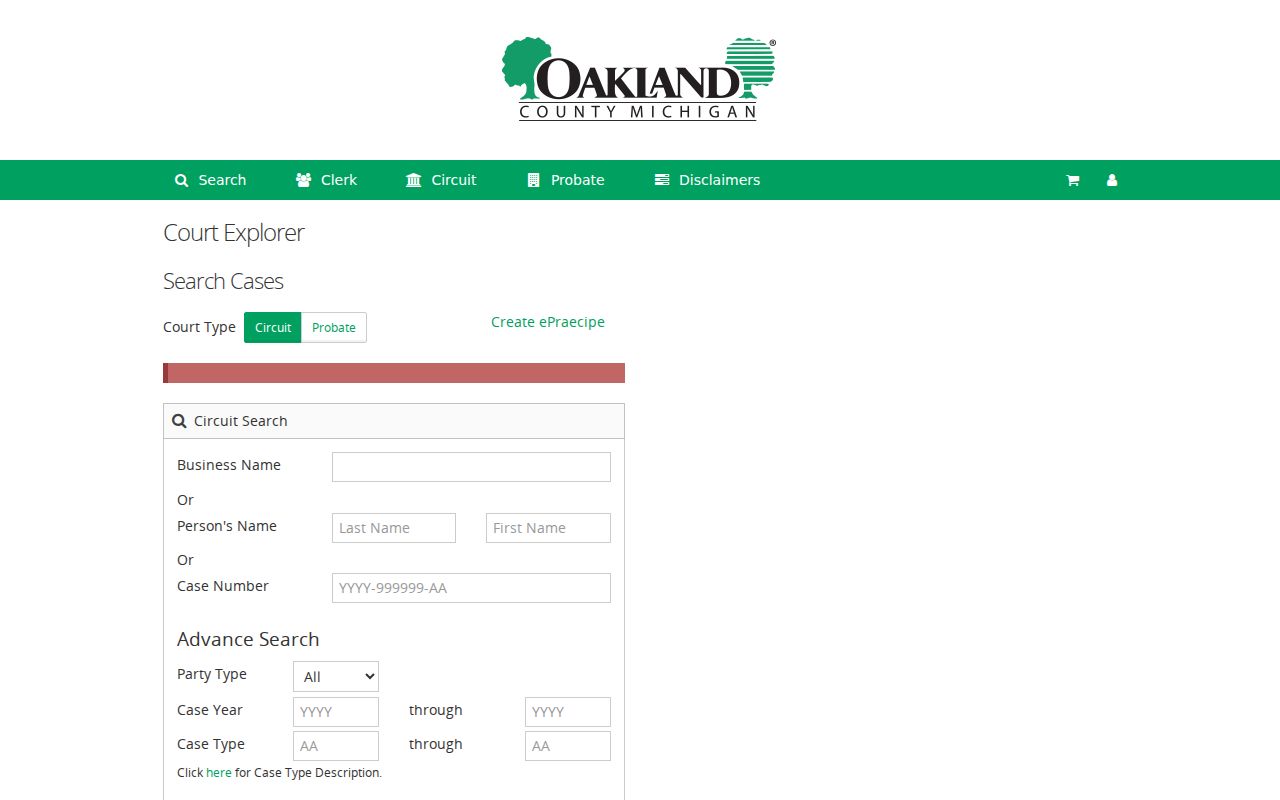
An independent Michigan portal may provide a stronger local register, while the Michigan clerk still controls documents and certified copies.
Reading Michigan Case Outcomes
Read the Michigan outcome by charge, not from the arrest label or case caption. One Michigan complaint can contain counts that end in different ways. “Pending” means the matter lacks a final result. “Dismissed” and “not guilty” do not mean the same thing, though neither is a conviction. “Nolo contendere” is a plea that can support a judgment when accepted. A bench-warrant entry records court action after a missed appearance or other issue, not the final result of the underlying count.
- Bindover
- Transfer of a felony from district court to circuit court after probable cause or waiver.
- Information
- The prosecutor-filed charging document used for the felony in circuit court.
- Disposition
- The recorded outcome of a charge, such as conviction, dismissal, acquittal, or transfer.
- Judgment
- The court's formal decision, including the sentence when a conviction is entered.
A missing disposition in an ICHAT report is a Michigan repository issue, not proof that the court never acted. Verify the Michigan clerk's case file. If that judicial segment is correct locally but absent from CJIC, ask the court to transmit the update or use its judicial correction route.
Note: A Michigan case register supplies the charge-by-charge outcome that an arrest entry alone cannot show.
County Sources for Michigan Case Records
The full Michigan criminal case file remains with the clerk where the matter was filed. Pick the county first, then choose district court for a misdemeanor or new felony and circuit court for a bound-over felony. Ask for the register of actions, complaint or information, orders, judgment of sentence, and certification as needed. The clerk can state current copy methods and fees, which vary by court.
Browse the directory of all 83 Michigan counties to reach the right county criminal-records site. That county route also helps locate independent court platforms and older-record instructions. Use Michigan State Police criminal history checks only for the compiled repository view. The rap sheet does not replace the originating Michigan court file, and the court file does not combine a person's reportable events from every county.