
The Michigan State Police at a Glance
The Michigan Criminal Justice Information Center, or CJIC, is the repository unit within Michigan State Police. Its role extends beyond the public Michigan rap sheet. Michigan CJIC connects criminal history, Michigan Incident Crime Reporting, LEIN and MiCJIN, traffic-crash reporting, the Sex Offender Registry Unit, statewide records management, firearms functions, and Michigan CJIS compliance. It also serves as Michigan's interface with FBI criminal-justice information systems.
The public does not gain access to that full Michigan network. ICHAT is a dissemination product drawn from the public part of Michigan criminal history. LEIN may contain warrant and wanted-person data that ICHAT omits. MICR supplies Michigan crime statistics rather than personal records. The official Michigan CJIC profile identifies these separate programs and contacts.
The current program structure is shown in the Michigan State Police CJIC services page.
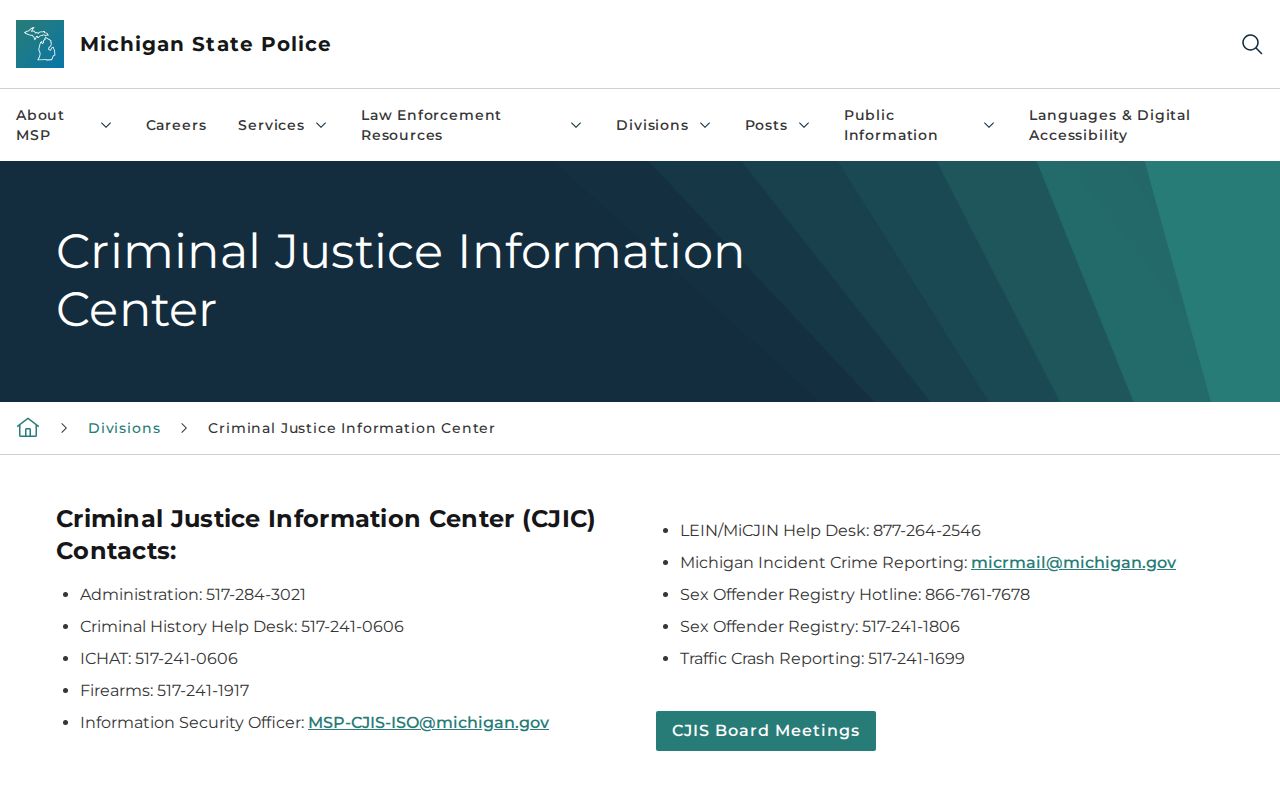
The service list makes clear why ICHAT, LEIN, MICR, PSOR, and crash records must not be treated as one database.
Michigan State Police Record History
Michigan's fingerprint identification and criminal-history authority began with Act 289 of 1925. The Michigan statute still requires defined submissions from peace officers, custodians, prosecutors, and court clerks. Michigan State Police renamed its Central Records Division as Michigan CJIC in 1999. The new title reflected a broader Michigan task: turn stored records into useful justice information. A 2000 reorganization then brought key electronic CJIS, LEIN, incident capture, and fingerprint functions together.
ICHAT was operating by 2005. Electronic reporting expanded during the same era. A 2008 audit found that more than 97% of arrests, charges, and dispositions were then reported electronically, while a data match added more than 43,000 older dispositions. Those figures describe a historical project, not a current accuracy rate. Modern work includes Clean Slate automation, internal quality dashboards, and a 2026 architecture assessment of LEIN and criminal-history workflows.
Authority. The Bureau of Criminal Identification and Records Act supplies the core Michigan reporting and repository rules.
What Checks Michigan State Police (MSP) Offers
Michigan State Police offers distinct products for distinct Michigan needs. ICHAT is the only public non-fingerprint Michigan criminal-history search. It uses names and demographic details. A personal fingerprint review is available to the person whose record is being checked and gives identity-confirmed Michigan information. Electronic Live Scan checks occur only under an authorizing Michigan law, rule, or order and route to the authorized recipient. A set-aside packet is a separate Michigan court-linked process.
| Product | Who May Order | What It Returns | Cost |
|---|---|---|---|
| ICHAT name search | Any public user | Public reportable Michigan criminal history | $10 |
| Fingerprint personal record review | The record subject | Fingerprint-matched Michigan record with one certified or notarized original | $30 plus local print fee |
| Statute-authorized Live Scan | Person using a request supplied by an authorized program | Michigan and, when authorized, FBI response routed to the named recipient | State, FBI, and vendor fees vary |
| Set-aside processing | Applicant filing in the Michigan convicting court | Michigan State Police record check and routing to required parties | $50 plus local costs |
| Public record amendment | Subject or public-report requester with source support | Verified change to an arrest, charge, or judicial segment | No separate challenge fee found |
The Michigan State Police Criminal History Records hub is the official starting point for Michigan product rules and exclusions.
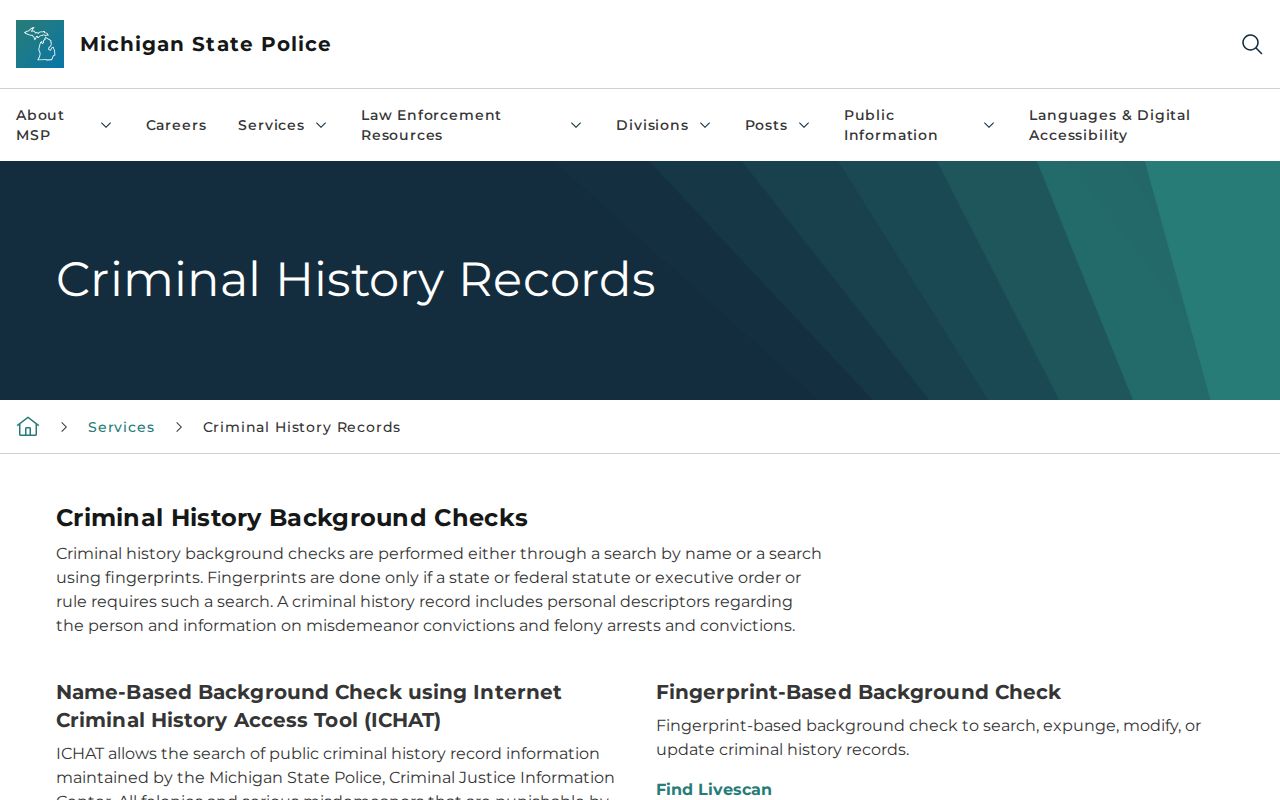
The hub separates ICHAT, personal review, correction, fingerprint, and set-aside channels instead of presenting one universal check.
Michigan State Police ICHAT Fields
ICHAT joins reportable Michigan records across all 83 counties. The name path requires a first and last name, date of birth, race, and gender. A known Michigan SID can serve as an alternative. Middle name, suffix, aliases, and a requester reference may help organize a Michigan search. Michigan State Police says not to place a Social Security number in the miscellaneous-number field.
A Michigan result may show the SID, FBI number, aliases, arrest charges, prosecutor charges, court outcome, sentence, probation, confinement, and fines, costs, or restitution. “No Data Received” means Michigan State Police lacks a source segment. “Warrant requested” describes a Michigan arrest-agency action and does not confirm a live warrant. Save the paid result promptly. An official Michigan state-plan guide says transaction results remain available that day and for the next seven days.
| Identity Path | Michigan SID, or required name and demographic fields. |
|---|---|
| Required Descriptors | First name, last name, date of birth, race, and gender unless SID is used. |
| Optional Match Aids | Middle name, suffix, additional names, and requester reference. |
| Public Coverage | Reportable Michigan felony events and serious-misdemeanor information maintained by Michigan CJIC. |
| Excluded Sources | Warrants, federal, tribal, out-of-state, traffic, juvenile, suppressed, and local 92-day misdemeanor records. |
The Path Into the MSP Repository
Michigan does not create one record at arrest. The arresting agency creates its report. If a qualifying event occurs, it collects fingerprints and descriptors. MCL 28.243 generally requires biometric submission within 72 hours for felonies, misdemeanors punishable by more than 92 days, and other listed arrests. The prosecutor contributes charge action. The district or circuit court later reports the judicial result and sentence.
Data flow: County Arrest › Fingerprint Submission › Michigan Department of State Police Criminal Justice Information Center › Court Disposition Reporting › Rap Sheet
Live Scan creates a transaction control number, or TCN. Prosecutors may add a charge tracking number, or CTN. The incident number can serve as the originating agency number. A missing or transposed identifier can leave a disposition unmatched even when the county file is complete. The court may use RI-027 when an electronic judicial correction is unavailable.
Fresh case detail stays with the local source. Use the Michigan county directory to find the arresting agency, prosecutor, and court that contributed a disputed record.
Michigan State Police Live Scan
Michigan has no single exclusive fingerprint contractor. Michigan State Police publishes approved government and private Live Scan locations, while some local law-enforcement sites print by appointment. Michigan State Police posts are not Live Scan sites. A Michigan statutory program provides the RI-030 form and its request codes. The applicant should never invent a purpose or agency code.
Michigan personal self-review works differently. A Michigan resident gets an RI-008 Applicant and Personal Identification Card locally. Even if a Live Scan device prints the card, the local site does not send that self-review electronically. The completed card, cover letter, contact details, and payment go by mail to Michigan CJIC. The result goes only to the fingerprinted person.
Available Michigan capture sites appear on the Michigan State Police approved Live Scan directory.
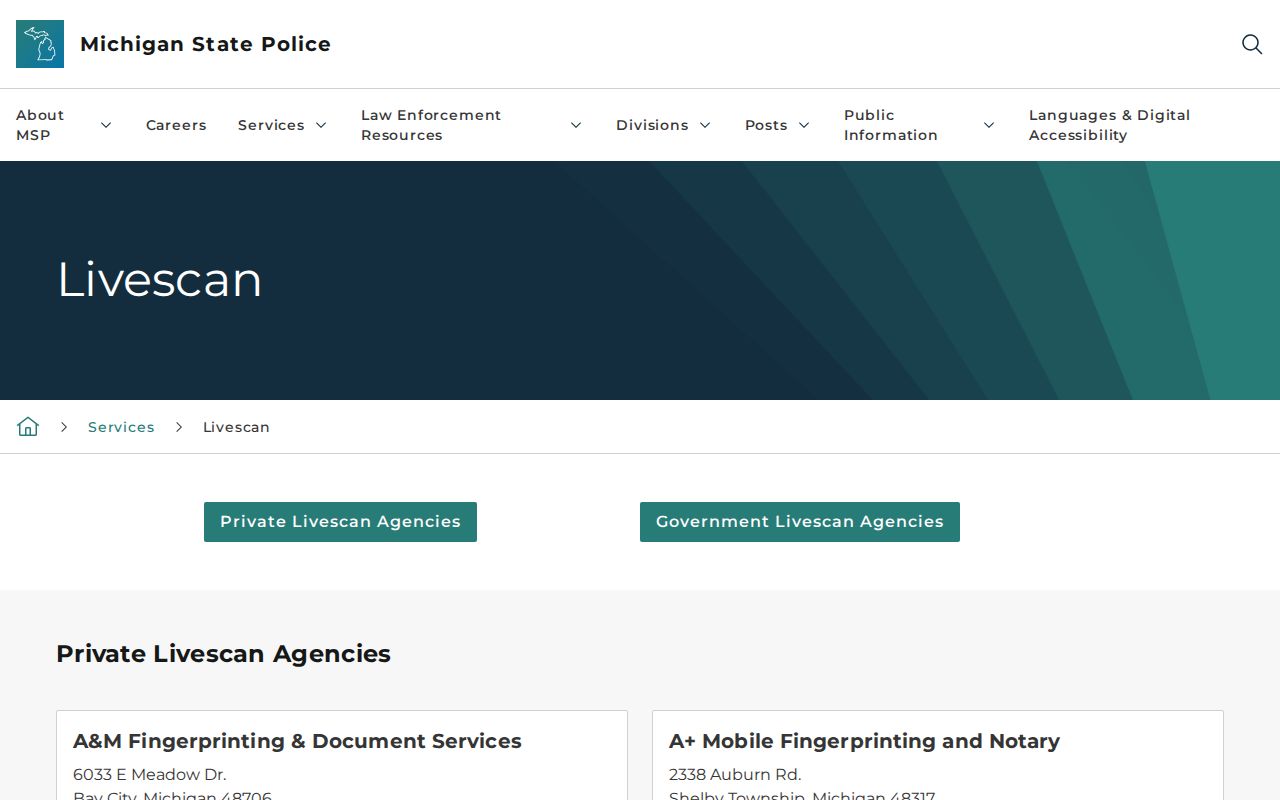
The location list should be checked before travel because appointments and site service fees are set locally.
MSP Check Ordering Steps
Choose the channel by the record needed. Use ICHAT for the public statewide slice. Use fingerprint self-review for identity certainty about your own Michigan file. Use a statutory Live Scan request only when the authorized program supplies it. Then obtain the county case file for complete pleadings, hearing history, orders, and certified copies.
- Select ICHAT, personal fingerprint review, or the properly authorized Live Scan route.
- Gather the required descriptors, fingerprint card, cover letter, or program-supplied request form.
- Submit ICHAT online, mail the RI-008 self-review packet, or visit an approved Live Scan location.
- Pay the $10 ICHAT fee, $30 Michigan State Police personal-review fee, or the exact Michigan program and vendor charges shown.
- Read each source segment, then request the county court record for any entry that needs detail or proof.
Michigan State Police reports an immediate ICHAT result, three to five weeks for a mailed Michigan personal review, and often seven business days or less for an authorized electronic check. Mail and local capture time can add delay.
Michigan State Police Self-Review
A fingerprint personal review avoids same-name uncertainty. A resident asks a local fingerprint location for RI-008 and completes the identity, signature, and reason fields. A nonresident may use an FBI FD-258 card obtained where the person lives and must state the exact reason. Include a cover letter with the return address and contact details.
The $30 fee provides one certified or notarized original. Additional originals cost $1 each. Michigan CJIC says to allow three to five weeks including mail. The official Michigan fingerprint review and correction instructions provide the current packet details.
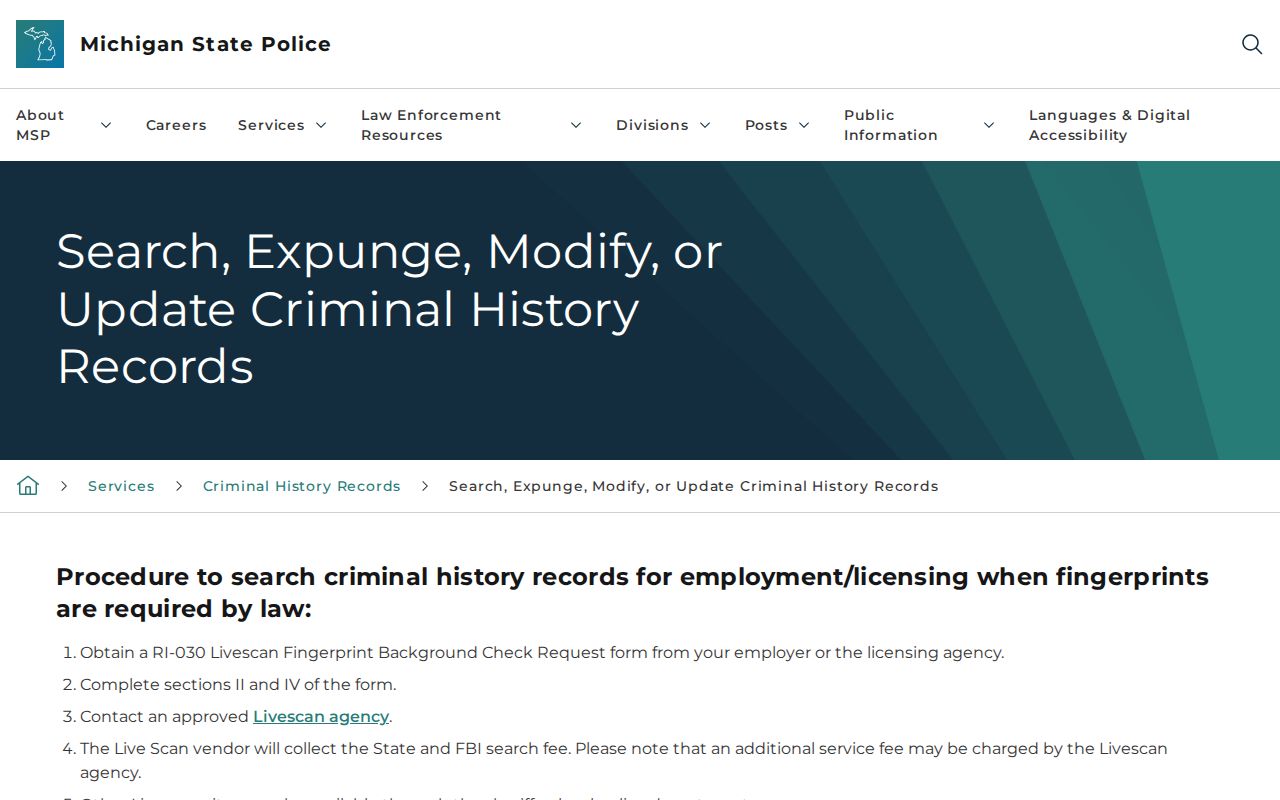
The fingerprint route is for reviewing your own identity-matched file, not for replacing the public ICHAT or county court channel.
Comparing MSP and County Records
A Michigan State Police rap sheet and a Michigan county court file answer different questions. ICHAT can join public reportable cycles from several Michigan counties. The Michigan county clerk holds the official register of actions, complaint, bindover record, judgment, orders, and certified copies. A recent booking may appear with a Michigan county jail before the full statewide cycle arrives.
| Michigan MSP Check | Michigan County Records | |
|---|---|---|
| Coverage | Public reportable events statewide | One county's original arrests and cases |
| Source | Fingerprint-linked agency, prosecutor, and court submissions | Police reports, jail entries, and district or circuit files |
| Timing | Depends on contributor transmission and matching | Updates as the local event or case proceeds |
| Detail | Compiled segment summaries | Documents, docket events, bond, hearings, and orders |
| Best Use | Joining public Michigan history across counties | Verifying one event, result, or certified document |
Neither source replaces the other. ICHAT is not the police narrative, and a court file is not a joined statewide rap sheet.
Michigan State Police Clean Slate
Michigan State Police and the Michigan Department of Technology, Management and Budget began automatic Clean Slate production in 2023. The Michigan repository and courts exchange a secure daily file for eligible records. Early official counts reported more than 1.18 million convictions processed for more than 842,000 people, followed by later 2023 figures of 1,353,237 convictions for 887,545 people. Those are Michigan historical milestones, not a live public total.
Set-aside records leave ordinary ICHAT access, but Michigan State Police retains a restricted nonpublic record for uses authorized by Michigan law. Display timing may differ when a short misdemeanor exists only in the Michigan court system. The Michigan State Police conviction set-aside guidance separates automatic relief from an application filed in the convicting court.
Application-based Michigan relief requires county court papers and a Michigan State Police processing step, while automatic processing follows Michigan statutory eligibility and data matching.
When Michigan State Police Shows No Data
“No Data Received” is not a generic no-record result. It identifies a missing arrest, prosecutor, or judicial contribution in a returned cycle. Start with the segment. Ask the arresting agency to verify arrest facts, the prosecutor to verify charge action, or the court to verify the outcome and sentence. The source office should transmit its correction electronically when possible.
A wholly empty ICHAT search is also narrow. It may reflect wrong descriptors, an excluded local misdemeanor, a warrant, another state, a federal or tribal record, juvenile material, or a set-aside entry. Search MiCOURT and the county file before concluding no Michigan event exists. ICHAT uses names and descriptors, not biometric identity.
The Michigan State Police forms library provides RI-008, RI-026, RI-027, and other current Michigan forms.
The form title and revision should be checked before filing because correction procedures and required attachments can change.
MSP Record Error Corrections
The current Michigan RI-026 is titled Request for Amendment of Public Criminal History Record. It asks for identity and contact data, the SID and FBI number from the record, a description of the error, signatures, an RI-008 fingerprint card, and a copy of the record to amend. Michigan State Police must verify a requested change with the office that supplied the disputed information.
- Order and mark the exact Michigan State Police record cycle and source segment that appears wrong.
- Compare it with the arresting agency, prosecutor, and county court source records.
- Ask the source to transmit a correction, or submit RI-026 with the fingerprint card, record copy, and support.
- Order a fresh copy after processing and confirm that the arrest, charge, or judicial segment now matches.
A Michigan court unable to update electronically may use RI-027 Judicial Correction Worksheet. Set-aside display concerns should also be checked with the convicting court and Michigan State Police Clean Slate. The Michigan Criminal History Help Desk is 517-241-0606, and the corrections email is msp-crd-crimhelp@michigan.gov.
Note: A set-aside removes qualifying information from ordinary public display but does not destroy every government-held record.